Saturday, 29 January 2011

Kingston University, 24th to 29th Jan 2011

I decided to call this post Kingston University because was our tutors merit to arrange some very interesting events and presentations.

24th January 2011

The week started with Graphic communication and techniques in Landscape Architecture by Colum O'Keeffe. Colum is a Landscape Architect working for Bernard Seymour Landscape Architects, a practice owned by Level 6 tutor in Landscape Architecture at Kingston University. It was very nice to see some good work examples from Colum, (www.bslarch.com) and learning some good techniques in autocad and photoshop. We worked from a base plan at scale 1:100 in autocad, the file was saved and other details such as trees were added in at right scale in autocad and textures of paving and vegetation was added in photoshop.

25th January 2011

The Tuesday afternoon was arranged with some interesting Landscape Lectures. All gests were young and enthusiastic with their work.

1. Heather Ring, Wayward Plants (www.waywardplants.org)

Heather was working for a practice for approx 4 years when she decided to run her own practice. She has worked hard and achieved a lot. Her approach was connected a lot with local communities in London and dealing with local government. Some of her interesting projects include a new orchard in community. Supported by local council she managed to hire a shop for free for one week to collect plants and Christmas trees with roots from local community. Another project designed from Heather is Algae garden designed for its ornamental look and as a potential for bio-fuel.
Algae garden


2. Christian Spencer Davies, AModels (www.amodels.co.uk)

Chris was the founder and director of AModels, a well known company on model making for Landscape Architects, Architects and Town Planners. He is a well trained and experienced model maker. Amodels have over 20 full time staff and during the years made models for so many different practices, including Diana Memorial designed by Gustafson Porter and some buildings designed by Zaha Hadid and many more. AModels has made so many extreme and challenging models such as masterplan for Croydon. At the end of his presentation his advice for us was to work for a practice to get as much experience as possible before thinking on running our own practice.

Ordrupgaard extension, Zaha Hadid Architects

3. Maria Smith, Studio Weave (www.studioweave.com)

Maria and Studio were previous students studying Landscape Architecture at Kingston. With so little experience they made a very challenging decision on running their own practice. Their portfolio was small but very interesting. The projects presented included a temporary structure (2 weeks) that was part of their degree project which was was built and the materials, (mainly timber) was redesigned and used to make street furniture. Other challenging project included a landscape area in Blackburn and a structure called Freya and Robin in Kielder Water.

Freya's Cabin

Freya and Robin

Blackburn's secret landscape garden


27th January 2011

On Thursday were some interesting lectures from Sam, Will and Trenton.
Sam from Gustafson Porter has been so many times in Kingston and we were so familiar with his presentation and approach to new Landscape projects.

1. Sam Johnston, Gustafson Porter (www.gustafson-porter.com)

2. Will Sandy, Three Green Dots

3. Trenton Oldfield, This is Not A Gateway (www.thisisnotagateway.net)


Friday, 14 January 2011

Thames Barrier Park


On Monday I and some other Landscape Architecture student went to explore the award-wining Thames Barrier Park, which was opened in 2000. The park is set within 22 acres of lawns, trees and hedges, the waterside park features fountains, gardens, wildflower meadows, a children's play area and a 5-a-side football/basketball court, with magnificent views of the barrier.

As we expected, there were not a lots of visitors in January, especially with the windy
say. The park looked attractive in the winter as well, its a good time to see how plants lo
ok in the winter, especially herbaceous (which were all cut back), grasses with their lovely autumn color and trees, deciduous and evergreen.

As seen on photos designer used a lot of straight lines (gravel paths) and to make the design unique the straight lines turn to open spaces, by using the same material but to keep up with the detail trees and other features are used to give a artistic continuous of lines. The design has got that 'romantic French feeling' withe the way of use of planting. Good example is the shape of Taxus Baccata (yew conifer hedges) that matches with the concrete shapes used to break up the deck platform...

There are some maintenance issues around the park. By looking a the photos i realized and i believe that the bark at the bottom of the tree is not being eaten by squires but by maintenance streamers, when the lawn gets cut.


Sunday, 2 January 2011

Regis Road Recycling and Re-use Centre - Camden Council

During this focus week I went to re-designed recycling centre in Kentish Town, North London. The new design is very simple and convenient for all household waste and commercial green waste. It is very convenient place close to Camden and Central London. 95% of waste collected on site is recycled and reused. All green waste collected from horticultural businesses is used to make compost and is sold again. Also the site offers access to schools and other learning institutions. It is important for us as landscape architects to know more about recycling and environment, because those are very crucial factors in design.
The following are some photos of the site...


Saturday, 6 November 2010

Gardening in Edgware, North London


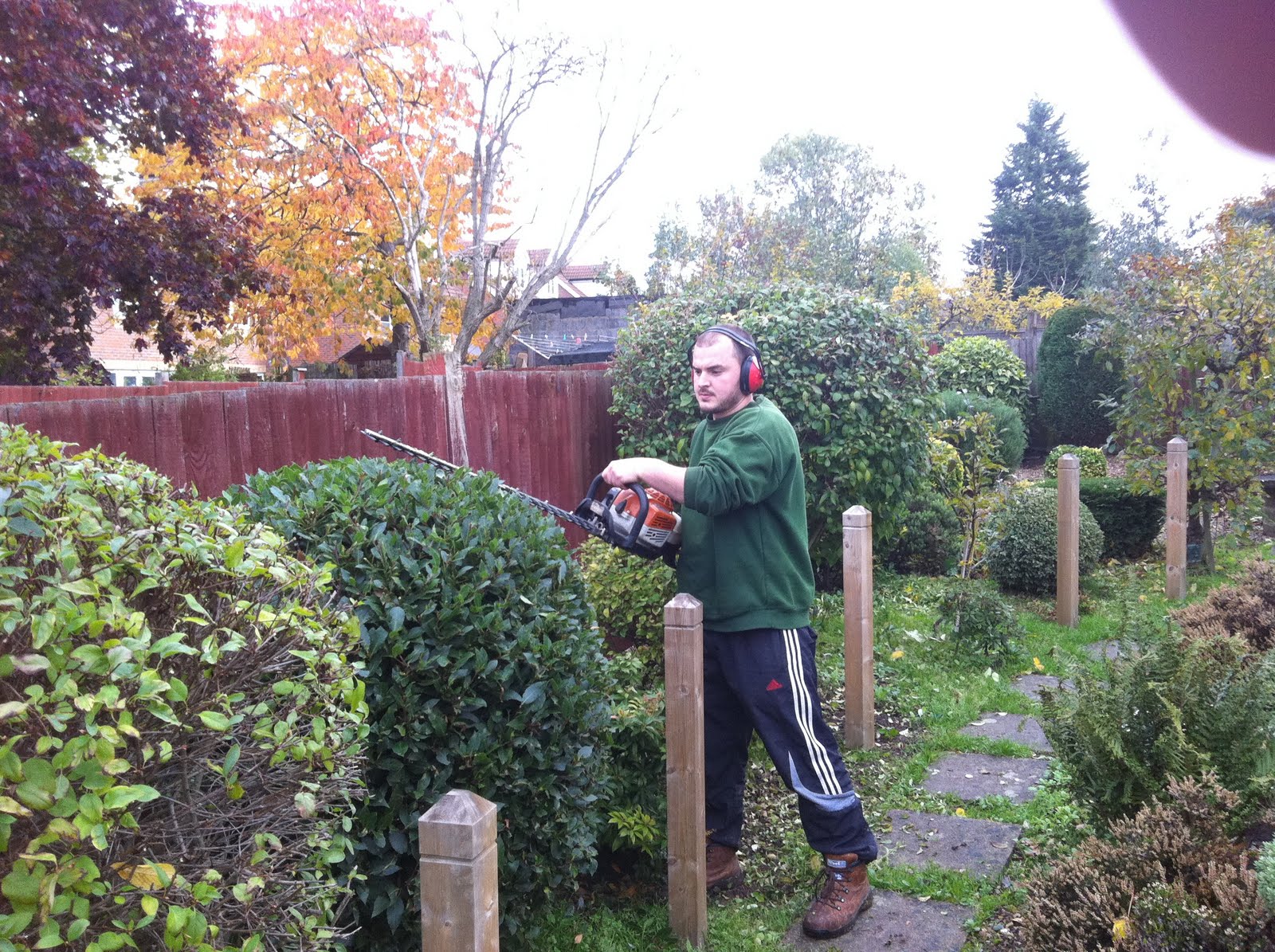
The garden tidy up included: weeding, clearing leaves and other debris, shaping of shrubs, cutting down and dividing herbaceous plants, shaping evergreen plants, pruning fruit trees, planting winter bedding and bulbs, turning over the soil.


A glue plastic is tied to the bottom of the tree will stop 90% of pest trying to climb the tree. This is a good practice and is usually used to fruit trees and helps them to produce better fruits without using any pesticide chemicals.


Pruning of fruit trees such as apples and pears is done in November, it is important that this is done correctly so the plants grow health and produce better fruits. There is some fruit trees such as cherries and plums (prunus spp) that usually are pruned after flowering to prevent silver leaf disease.


There are some perennial plants that like a really gently pruning, this group includes most of acid loving plants such as pieris, rhododendron and magnolias.


Two eunoumus spp planted together and shaped as a single one, looks nice doesn't it?


Me shaping plants such as sweet bay, forsythia, abelia etc. all timber posts in this garden are used to help the owner (disabled lady) move around and enjoy her garden.
Gardener or Landscape Architect?
When people ask us about our profession, we tell them that we are Landscape architects. Sometimes they think that this is type of gardening design and landscape. Well, we don't get impresed when we are called 'gardener'. We know that a Landscape Architect is more than a gardener or garden designer/landscaper, however we know that we have to collaborate with this category of people when designing.
It is important for us to know about plants, landscape materials and maintenance. I believe that when designing we should include a maintenance programme for our design. The maintenance programme and average yearly maintenance cost. This can make the design look good at all time and keep its values for long.
I hope all this will encourage Landscape Architects to learn more about plants, role in design and maintenace.


Friday, 5 November 2010

O2 Centre

O2 centre in Greenwich is a new contemporary design in East London. Landscape materials and plants used in design are unique and great to get ideas and inspiration in our designs. Focus week helped us to travel and see new built designs, learn new things, visit exhibitions. That makes this module very different from others and allows us to explore landscape and have fun.


Ghost Forest

Ghost Forest Exhibition, University museum, Oxford, July 2010 - July 2011


All those tree roots from the worlds vanishing forest have been
transported from West Africa and Brazil. They are displayed in
the front of Oxford's University Museum of Natural History. It was a

good experience looking at all those giant tree roots in the front of you. as we know trees have a great value for people and landscape. It is shame to hear and see TV programmes how people in third world countries cut down so many trees and destroy so many forests (the size of a football pitch is destroyed every 4 seconds).


Alive this trees stand 61 meters high (taller than Nelson's column).
These trees were supplied from a sustainable tree industry and only three trees of Ghost Forest were logged, the rest falling in adverse weather.

I spent the rest of the day walking around Oxford city, finishin my jurney at Oxfords Castle and having a coffeee in a roof garden.


Thursday, 20 May 2010

Presentation from different practices

Arups
Arups is a multidisciplinary international Landscape Architecture practice. We had a presentation from two Landscape Architects talking about detail and design in large scale. It was nice to see how they worked, with a lot of staff specialised in different things. I enjoyed their presentation and the projects that this two Landscape Architects were involved. One of the was specialised in engineering and construction and the other one more in designing and planting.

Capita Lovejoy -Martin Kelly
Trees lecture

Martin Kelly is the director of Capita Lovejoy. He had a long term experience with land and trees. In his presentation we saw some images comparing the existing Thames water front with Plane trees and how the are could have been without trees. That was the time that i really anderstood the importance of trees. Also he showed some other projects by Capita lovejoy. I really enjoyed his presentation.


Gustafson Porter
Sam, detail lecture - Old Market Square, Nottingham

Gustafson Porter it is a practice based in Kentish Town, North London, Sam was working for the practice for the last 6 years. He discussed the landscape detail in old market square, Nottingham. He explained how the designed the square and the process of creating a detailed plan of granite paving and water feature and a model to understand the way in which the water would flow. Also Harry from level 6 is working part time for the practice. He had his say about the experience of him involved in different projects and his main tasks. was nice to hear from a student and his experience working in a practice.